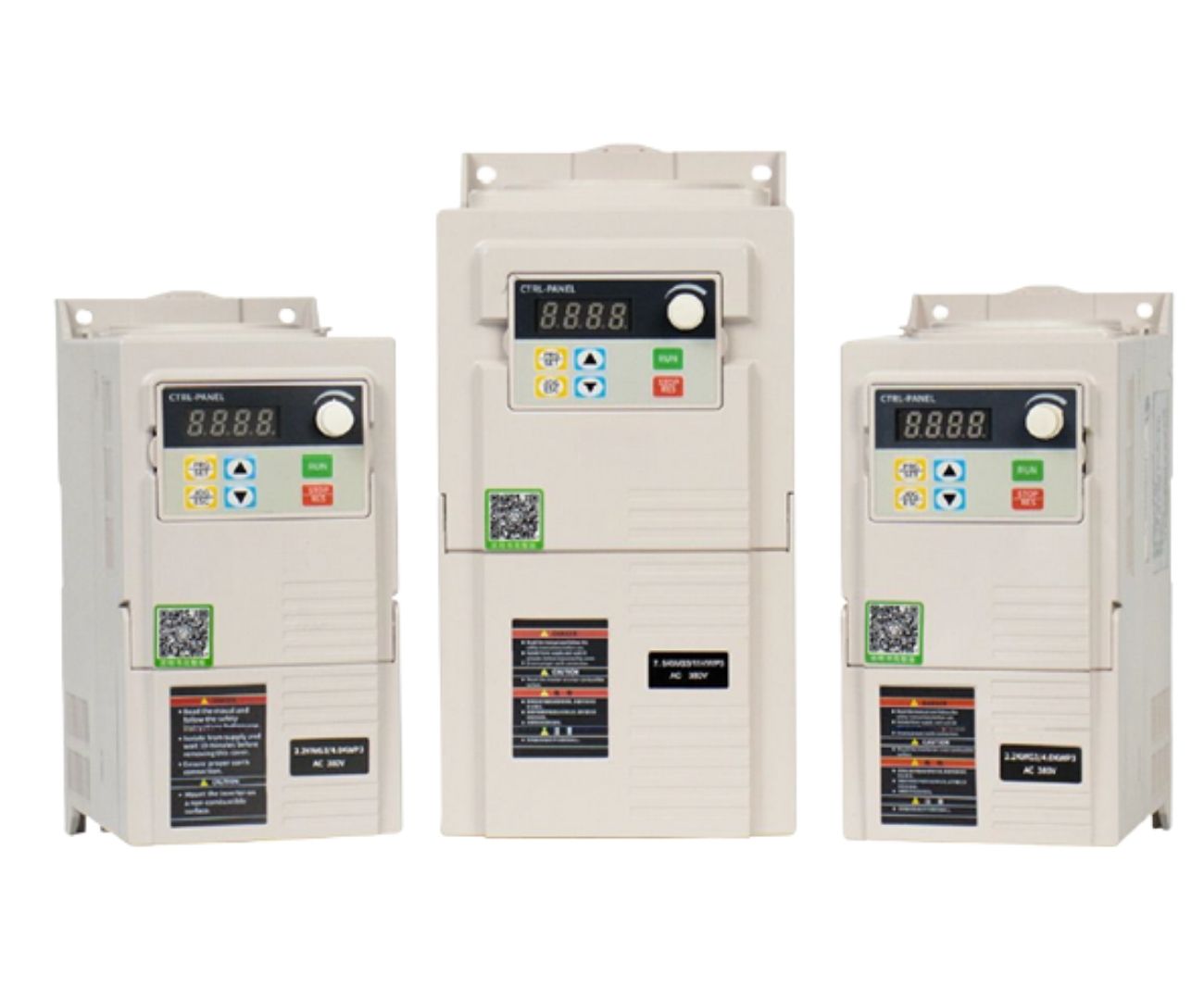

The control methods of inverters are diverse and varied, each like a unique musical piece with its own melody and rhythm, adapting to the needs of different industrial scenarios. Among them, V/F control, vector control, and direct torque control are the three most common and widely used control methods, each with its own characteristics in terms of principles, performance, and application scenarios.
-
V/F Control: V/F control, or voltage-to-frequency ratio control, is a basic and classic control method. Its core principle is to change the motor’s power supply voltage V in proportion to the change in the motor’s power supply frequency f, maintaining a constant ratio of voltage to frequency (V/f). This is because the motor’s magnetic flux is closely related to voltage and frequency. Keeping the V/f ratio constant ensures that the magnetic flux remains largely unchanged during speed regulation, thereby maintaining relatively stable torque output. During speed regulation, when the frequency decreases, the voltage also decreases accordingly; when the frequency increases, the voltage rises accordingly. This control method has a simple structure, low implementation cost, and is easy to understand and operate, making it widely used in fields with low technical requirements. In some small fans, water pumps, and other equipment where speed regulation accuracy is not critical and load changes are relatively stable, V/F control can operate stably, meeting basic speed regulation needs and achieving a certain degree of energy-saving effect. However, V/F control also has some limitations. Since it uses an open-loop control method, it cannot make precise adjustments in real-time based on the motor’s actual operating state, resulting in relatively limited control performance. At low frequencies, the motor’s torque output can be affected, leading to insufficient torque and reduced load-carrying capacity. Additionally, for situations with significant load changes or high dynamic response requirements, V/F control often struggles to meet the demands, leading to issues such as large speed fluctuations and slow response times.
-
Vector Control: The emergence of vector control technology was like a revolution in the field of inverter control. It is an advanced control method based on the dynamic mathematical model of the motor. The basic idea of vector control is to decompose the stator current of an asynchronous motor into a magnetizing current component and a torque current component through complex coordinate transformations, as if dissecting a complex current into two currents with specific functions, and then independently and precisely controlling these two components to achieve precise control of the motor’s torque. This decoupling control method allows asynchronous motors to match the speed regulation performance of DC motors, offering high-precision speed and torque control capabilities. In the spindle drive systems of CNC machine tools, vector control can precisely control the motor’s speed and torque according to the requirements of the machining process, achieving high-precision machining of workpieces and ensuring the flatness and dimensional accuracy of the machined surfaces. Vector control also has excellent dynamic response characteristics, enabling it to quickly respond to load changes, allowing the motor to rapidly adjust its output torque and maintain a stable operating state. However, vector control technology also faces some challenges. It requires accurate estimation and setting of motor parameters, such as resistance, inductance, and the number of pole pairs, as the accuracy of these parameters directly affects the control performance. If the parameters are not set accurately, it may lead to reduced control accuracy and system instability. Additionally, vector control algorithms are relatively complex, requiring powerful computational capabilities, which places higher demands on the controller’s performance and increases hardware costs and system implementation difficulty.
-
Direct Torque Control: Direct torque control is a control method that directly targets torque as the control objective. It takes a different approach by analyzing and controlling the motor’s mathematical model in the stator coordinate system. Direct torque control directly detects the motor’s stator voltage and current, uses a unique algorithm to quickly calculate the motor’s flux and torque, and then directly controls the torque without the need for complex coordinate transformations like in vector control. This control method has the significant advantage of rapid torque response, being able to react to torque changes in an extremely short time (usually within 1-5 ms), with outstanding dynamic performance. In some applications requiring extremely high torque response, such as the lifting process of cranes, direct torque control can enable the motor to quickly output the required torque, achieving smooth lifting and rapid movement of heavy objects, improving work efficiency and safety. Direct torque control also has the characteristic of relatively simple control algorithms, making it easy to implement and understand. However, direct torque control also has some drawbacks. Due to its use of “bang-bang” control (two-position control), the harmonic components of the output current are large, which can increase motor noise and vibration during operation, affecting the motor’s lifespan and operational stability. Additionally, at low speeds, the torque ripple issue in direct torque control is more pronounced, making the motor’s speed less stable and limiting its application in scenarios requiring high low-speed performance.
To more clearly understand the characteristics and differences of these three control methods, we can compare them through the following table:
| Control Method | Principle | Advantages | Disadvantages | Application Scenarios |
|---|---|---|---|---|
| V/F Control | Maintains a constant V/f ratio | Simple structure, low cost, easy to implement | Low speed regulation accuracy, poor low-frequency torque, slow dynamic response | Scenarios with low speed regulation accuracy requirements and stable load changes, such as small fans, water pumps, etc. |
| Vector Control | Decouples stator current into magnetizing and torque currents for separate control | High speed regulation accuracy, good dynamic performance, strong low-frequency torque | Requires accurate motor parameters, complex algorithms, high cost | Scenarios with high speed regulation accuracy and dynamic performance requirements, such as CNC machine tools, elevators, etc. |
| Direct Torque Control | Directly detects and controls motor flux and torque | Fast torque response, simple control algorithm | Large current harmonics, significant torque ripple, poor low-speed performance | Scenarios with high torque response requirements and relatively low motor noise and low-speed performance requirements, such as cranes, rolling mills, etc. |
Leave Comment